not-things VCV Rack modules
RAMELIG and RATRILIG Samples
Part of the set of not-things VCV Rack modules.
Below are links to and descriptions of some simple patches containing Ratrilig and Ramelig to demonstrate some of their basic behavior
Basic Ratrilig into Ramelig
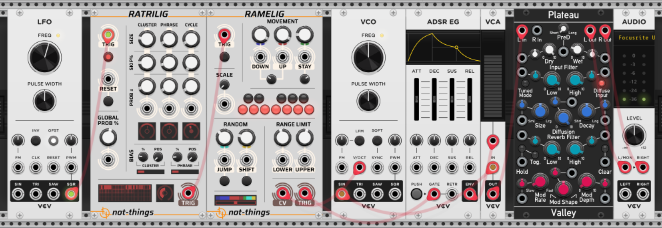
The Basic Ratrilig into Ramelig patch contains a very basic setup:
- A VCV LFO provides a constant clock signal (4 beats per second)
- The clock signal is sent into Ratrilig to generate a trigger pattern. All Ratrilig parameters are at their default values
- The output of Ratrilig is patched into the trigger input of Ramelig to let it generate note sequences. All Ramelig parameters are at their default values
- The output of Ramelig is used to let a VCV VCO-ADSR-VCA combination play the generated note and rhythm sequence
- The plateau reverb adds some color to the sound before sending it to the Audio output module
Ratrilig into Ramelig with chords
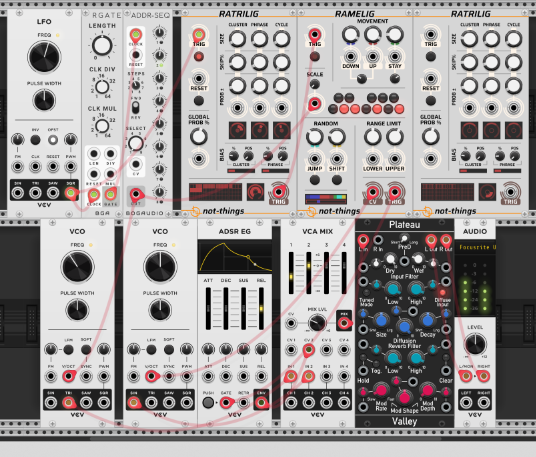
The Ratrilig into Ramelig with chords patch builds upon the basic patch by:
- Setting up a Bogaudio ADDR-SEQ with a 4-chord progression: C, E, A and F. This sequence is advanced using the LFO clock, but with a 16x clock divider in between.
- The chord progression is played on a second VCO, which is set one octave lower
- The chord progression is also sent into the Ramelig scale CV (which is set to Chromatic 1V/Oct mode in the right-click menu). The stored scales in Ramelig are set up to only play the notes of the active chord
- On Ratrilig, the gates per cluster have been reduced to 4 and all Skip chance values have been reduced (and disabled for the cycle)
- On Ramelig, the lower and upper range limit has been increased by one octave (i.e. 1V)
- Since two voices need to be mixed together (the chord root notes and the melody line), the VCV VCA is replaced with the VCV Mixer module
Simple RM-X expander usage
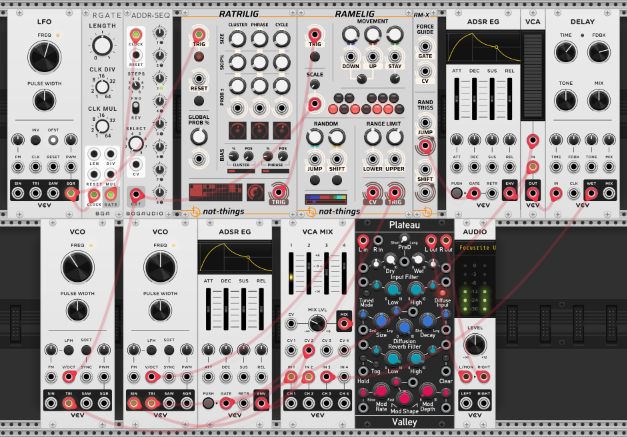
The Ratrilig into Ramelig with RM-X expander patch continues from the Ratrilig into Ramelig with chords patch, and adds a simple usage of the Ramelig expander (RM-X):
- The RM-X module is added to the right of Ramelig
- The JUMP trigger output is connected to a new VCV ADSR module
- The ADSR Envelope output drives a VCV VCA, which is connected to the Triangle output of the melody VCO
- The resulting notes are sent into a VCV Delay module
- The WET output of the delay module is mixed in with the rest of the patch audio.
The result is that any time a Jump action is performed by Ramelig, the resulting note will be repeated by the delay module, using the Triangle sound instead of the Sine output (i.e. a bit more present in the mix).